

In this personal and theoretical essay I reflect on my cinematic journey as a director and filmmaker. It developed through the meeting of personal research, practical production and theory. In my films, death returns as threat, absence, grief, erosion of identity and awareness of mortality. At the same time, the form of each work follows the narrative, from the completely static camera and off-screen sound to handheld camera, electronic zoom, pan and tilt, long takes and stillness.
This article is a personal retrospective by Yorgos Keramydas (Greek: Γιώργος Κεραμυδάς) on the making of eleven film works. At the same time it examines the relationship between his filmmaking practice and his study of Hitchcock’s films, Gilles Deleuze’s theory, existential philosophy, psychoanalytic theory, semiotics and narratology.
Before My Studies
Personal research, Hitchcock and an early personal system of principles for cinematic narration
My relationship with cinema began well before my first film. Watching Psycho at the age of twelve was a decisive experience. At the time I could not analyse the function of editing, subjective shots or sound, but I could feel the precision with which the film directed my attention and my fear.
In the years that followed I began to study Hitchcock’s films on my own. I was drawn to the way he organised suspense, to the relationship between what the character knows and what the audience knows, and to the way an object or a close shot can change the direction of an entire scene.
My interest gradually expanded to the different stages of production. I studied screenwriting, preparation, direction, shooting and editing. I tried to understand how a story becomes a succession of images and sounds. I paid attention to when information is given, when it is delayed, how long a shot lasts and what changes when the same person is filmed from a different distance or angle.
Before beginning my studies, I had already written down a list of personal criteria for how I ideally wanted a film to function. Today I approach some of those views with greater caution, yet that list shows that my first film emerged from a fairly specific system of thought.
I believed that the spectator first needs time to recognise the faces and their place in the story. Simplicity of narration seemed essential to me, even when the subject was complex. The protagonist had to be an ordinary person facing an immediately understandable problem. The past belonged in the film only when it had a real effect on the present action.
From Hitchcock I kept above all the principle that information creates suspense. The spectator needs to understand what is being watched, who is in danger and what may happen. When the audience knows about a danger before the character does, anxiety is created because it waits for the moment when the threat will be recognised. Delay or concealment of information, by contrast, can produce mystery, surprise and uncertainty.
I also attached particular importance to visual narration. Charlie Chaplin was, for me, an example of cinema that could be understood through movement, face and body. Speech occupied a supplementary place in my thinking. I also believed that the camera should remain as close as possible to the protagonist’s experience, so that the spectator would discover the world together with him.
Moral causality was equally important. I was interested in the character who does something blameworthy and then has to confront the consequences. Weakness could strengthen the audience’s sympathy. A person or object that would later become decisive ought to have appeared earlier, so that its return would arise organically from the organisation of the story.
I had also noted the importance of shot size, speed of movement, the use of a static or moving camera, music, and the alternation between tension and relief. For me, music expressed the inner state of the character. Changes in the rhythm of the shots and of the actors could create fear, mystery or contrast.
That old list records my first coherent idea of how I wanted a film to work. It was grounded in classical narration, clear causality, emotional identification and the control of information. Many of those principles already appear in Play Deaf. Others changed through the films that followed.
My engagement with graphic design also influenced the way I see the image. It familiarised me with colour combinations, contrasts and visual balance. Within a composition, a very bright area, a strong colour, a large object or a human figure can gather a great deal of visual weight on one side of the frame. Brightness, saturation, scale and the position of elements affect the way the spectator’s eye moves.
My general method is based on the effort to make form participate in narration. The choice between a static camera, handheld camera, zoom, pan, tilt or a long take is connected to the character, the atmosphere and the information that must reach the spectator. The same applies to light, colour, composition and sound.
From a Personal Method to Theoretical Inquiry
My studies gave theoretical language to an already existing direction
My studies were not the starting point of my interest in cinematic form. They offered me the theoretical language with which I could describe, test and revise what I was already trying to do.
The analysis of Hitchcock’s work was the first stable point in that encounter. I studied the function of subjective shots, close-ups, analytical découpage and the distribution of information. At the same time, auteur theory helped me think about the repetition of themes and formal choices within a filmography.
Auteur theory functions as a method of observation. It allows recurring patterns in space, time, characters and filming style to be recognised. In my own body of work, death, confinement, guilt, objects and the spectator’s limited knowledge return in different forms.
Gilles Deleuze’s theory gave me a more complex way of understanding Hitchcockian suspense. In the notion of the mental image, or relation-image, the interest lies in the connections among characters, objects, actions and pieces of information. The spectator is invited to interpret a network of relations. An image acquires meaning through what precedes it, what is delayed and what may follow. This logic directly influenced Eternal Home.
Existential philosophy added another level. In Jean-Paul Sartre, freedom is linked to the responsibility of choice even under restrictive circumstances. Martin Heidegger treats the awareness of death as a possibility for redefining existence. Albert Camus considers human life in the face of the absence of any final guarantee of meaning. This line of thought helped me see and handle death in my films as a limit that reveals the character’s stance toward freedom, other people and the self.
Later, psychoanalytic theory brought desire, lack, fantasy, the gaze, the image and the Other to the foreground. Christian Metz connects cinema with the imaginary and with a form of identification that keeps the spectator’s desire active. Sigmund Freud offers the concepts of condensation and displacement for understanding the dream. Lacanian theory allows identity to be examined as a relation to an image of the self and to the gaze of others. These ideas were directly connected to Strange Daniel and influenced the path that led me to make Oneiroramma.
Semiotics and narratology led me to a more systematic examination of objects, sounds, time and the spectator’s knowledge. Cinema can be studied as an organised relation among images, sounds, spaces and temporal choices. The meaning of each shot is affected by its place within the sequence, its duration, the sound that accompanies it and the information that has preceded it.
Narratology also helped me think about cinematic time through shot duration and the relation between image and sound. In Sleep Instructions for Mortals, the hero’s movement freezes while the television image and the sound environment continue. Two different temporal experiences are formed within the same shot. Form thus acquires dramaturgical meaning and expresses the anxiety of a person who realises that time and things can continue without him.
These theoretical fields did not all appear in my work at the same moment. Each film is connected to a different stage of study and practical experience. That is why it matters to examine them chronologically.
Eleven stages of an evolving cinematic language
Play Deaf
Absolute stillness, off-screen sound and moral responsibility

Play Deaf was my first completed film and the most direct application of the personal method I had shaped before my studies. The production was built on strict restrictions. The camera remained completely static. There was no pan or tilt, no displacement and no change of position during the shots.
No dialogue, voice-over, intertitles or music were used. Despite its short duration, the story was organised in three acts. The shoot was carried out with limited lighting equipment, using two spotlights.
An ordinary man realises that a serious incident of domestic violence may be taking place in the next apartment. The action that creates suspense is not always shown in the image. It often reaches the spectator through sounds and reactions.
The choice of a completely static camera is linked to the protagonist’s inability to gain full access to the event. The frame cannot move toward the source of the sound. It remains trapped with him. The restriction of vision intensifies listening and transfers the dramaturgical function to off-screen space.
The spectator knows enough to understand the danger. The impossibility of immediate confirmation places the audience in the same uncertain position as the protagonist. The absence of the violent act from the image also has an ethical function. The spectator does not watch violence as spectacle, but confronts its traces and is invited to consider how much certainty a person needs before acting. This distribution of information follows the Hitchcockian logic of suspense, while restricted focalisation keeps the spectator’s knowledge close to the protagonist’s position.
Death appears as a possibility. The film does not need to confirm whether the violence will lead to an extreme outcome. The threat is enough to create a field of responsibility. The protagonist can intervene, seek help or pretend not to have heard. His inertia becomes a stance toward a possible catastrophe.
Play Deaf follows many of my early principles. The character is introduced through action, the problem becomes understandable quickly, body language replaces dialogue and information is limited by the character’s position.
Eternal Home
Pan, tilt, objects and the relation-image
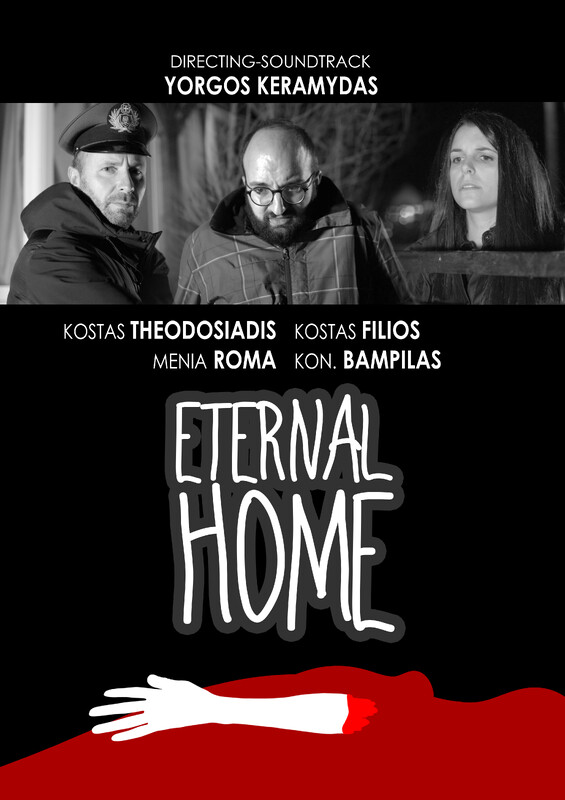
Eternal Home was my first attempt to make a more developed film with multiple characters, a clear dramatic structure and more complex relationships. Its point of departure was the social issue of foreclosures. A man returns to his family house in the village and discovers that his father has murdered a prospective buyer. When the victim’s wife appears, he takes it upon himself to protect his father and the family property.
The story unfolds mainly in the yard of the house. The space is outdoors, yet it remains strictly organised around the concealment of the crime. The soil, the burial spot, the tools and the movements of the characters turn the yard into a field of actions, evidence and moral pressure.
In the film’s initial note I had described my intention to combine an understandable suspense story with theoretical and philosophical foundations. The narration was designed in three acts, with specific turning points. Objects were used for plot development, characterisation and the spectator’s misdirection.
The cinematography followed a different tactic from the total stillness of Play Deaf. I used pan and tilt to follow the protagonist as he moves through the yard, carries objects and digs. The camera links bodily labour to the effort of concealment and keeps visible the relationship between the hero and the space in which he acts.
For lighting I again used two spotlights. The black-and-white image removes the yard from its ordinary appearance and intensifies the feeling of a crime story. Composition and camera movement organise the gaze around faces, tools, soil and the points where the truth may be revealed.
As Sotiris begins to dig, the external observation of the action is interrupted by a subjective and expressionistic cluster of images. The unstable close-up of his face, the knife against a black background, the superimpositions, dissolves and slow motion do not simply reconstruct the crime. They convey the way violence enters the protagonist’s thought, as the movement of the shovel toward the soil becomes connected with the blows and stabbings he imagines.
The film is connected to the Hitchcockian logic of suspense, while its more substantial theoretical relation lies in Deleuze’s concept of the relation-image. The corpse is the starting point. Tension is produced by the relations among the son, the father, the victim’s wife, the policeman, the yard and the objects that may lead to revelation.
This choice acquires its clearest existential dimension in the digging sequence. The protagonist is left alone with his blurred thoughts and personal fears. He is not responsible for the initial murder, but concealment has now become his own act. Family loyalty and the fear of losing the house do not cancel the freedom of the choice or the responsibility that accompanies it.
Subjectivity continues through sound. While covering the grave, Sotiris hears imagined conversations between Anna and the police. At first, he imagines Anna reporting the crime. Once he believes that concealment is complete, he hears a reassuring version in which the police have visited the house and found nothing. The device was influenced by Psycho, where Marion hears conversations she could not actually know. Because the voices are presented as ordinary dialogue rather than as a conventional internal monologue, the spectator may temporarily take them as real or as an image of a future event. The protagonist’s fears and wishes therefore do not only reveal his mental state; they also misdirect the spectator about what is about to happen.
The spectator follows the relationships and tries to anticipate when they will be exposed. A close shot of an object can inform, misdirect or prepare its future function. Meaning is formed by the object’s position within the network of actions.
The making of the film is also connected with my first substantial contact with theatre. I had no previous involvement with it. While searching for actors I visited Voreio Pedio, where I met people with whom I could collaborate. I then began to attend theatre workshops.
That experience helped me better understand the acting process, stage presence, the intention behind an action and the way a director can communicate with the actor. I began to grasp the difference between a general emotional instruction and a specific action an actor can perform within a scene.
Metamorphosis
Handheld camera, daylight and an ambiguous “metamorphosis”
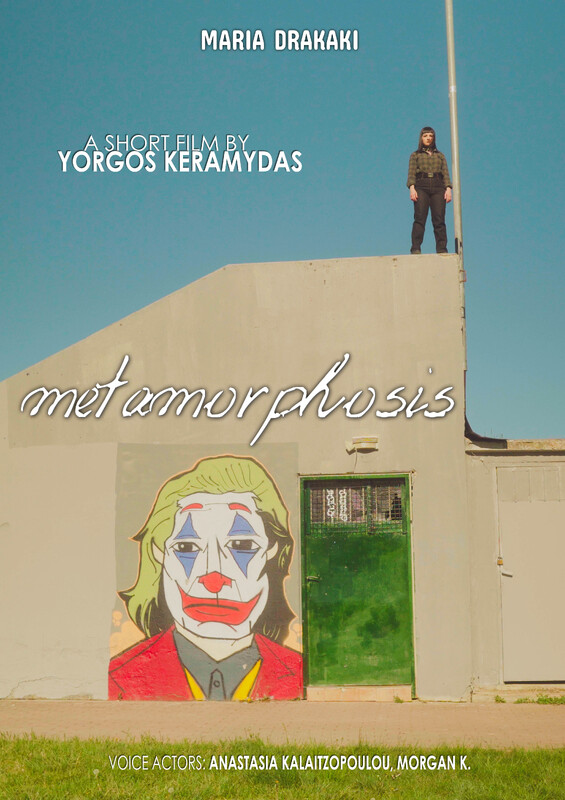
Metamorphosis turned toward inner narration and toward a subject connected with freedom, isolation and the changing relationship of a person to the world. A woman becomes disappointed with her social environment and chooses to withdraw from it. The loneliness she initially perceives as a possibility of liberation gradually becomes a suffocating restriction.
Her final “metamorphosis” remains ambiguous. It may be understood as a definitive withdrawal, as an inner transformation, or as the moment when the heroine feels invisible and invulnerable to what had previously wounded her. The film leaves the spectator free to decide what has happened and what exactly this change means.
This ambiguity is linked to existential freedom. The heroine chooses her stance toward a world she can no longer tolerate. Her choice changes her relation to others and to herself. Freedom is initially accompanied by isolation, while in the end the sense of invulnerability presupposes the loss of visibility and of human contact.
Metamorphosis was the first film in which I held the camera in my hands. The move from the completely static camera of Play Deaf to the handheld camera was connected to my desire to come closer to the body and the psychological instability of the heroine.
The shoot took place during the day, in natural sunlight. This condition differed from the dark and controlled atmosphere of the earlier films. The brightness of the outside world creates a contrast with the heroine’s inner estrangement. Her crisis does not hide in darkness. It unfolds beneath a visible, luminous and seemingly normal world.
I also used first-person narration. Narratively the voice belongs to the heroine herself, although the vocal performance was done by a different actress. The distance between the body that appears in the image and the voice that expresses its thoughts creates a small internal fracture. The heroine sees and comments on herself as if she has already stepped away from her own identity.
The voice allows direct access to her inner world, while the handheld camera conveys the bodily experience of instability. Image and narration work as two different levels of subjectivity. One records the body in space, the other expresses the way the heroine understands her position.
The film is linked to existential thought about freedom and alienation. The heroine no longer accepts being defined by the gaze of others. Her final condition can be read either as liberation or as loss.
The Sociopath
Static framing, electronic zoom and a forbidden internal monologue

The Sociopath is organised around an image of death that has lost its usual ritual and emotional place. A man leaves his mother’s dead body decomposing in the living room and continues with his daily routine. The situation is revealed when a neighbour happens to see the corpse.
The camera is static. This stability creates the sense that the space is being observed like a closed system. Within the shots I used electronic zoom, because the slow and visibly mechanical approach to a face or to an object served the atmosphere of the uncanny.
The zoom does not imitate the movement of a human being drawing closer. The image enlarges without the camera travelling through space. This disembodied approach creates the sense of a gaze that penetrates the scene. The familiar living room and the hero’s everyday actions thus acquire an altered quality.
It was also the first film in which I myself played the main character. At the same time I took on the writing, directing, camera, sound, editing and the other sides of production. My participation in theatre workshops had given me greater confidence with acting and helped me test the simultaneous position of director and performer.
That condition created a particular form of self-direction. I had to organise the static frame, predict the position and duration of my own movements and evaluate the performance mainly through the takes and the editing. The character’s limited outward mobility suited that process, because the performance relied on posture, gaze, rhythm and small gestures.
The character also functions as narrator through an internal monologue. The voice gives access to his personal logic. I wanted spectators to feel that they were hearing something that would normally have to remain hidden.
Voice-over narration can create intimacy, authority or doubt. In The Sociopath, the voice acquires an almost forbidden intimacy. The spectator hears how the protagonist approaches his mother’s death without necessarily sharing his thinking.
The influence of Albert Camus’s The Stranger lies mainly in the character’s emotional distance from the socially expected responses to death and in the sense of a world that offers no ready-made moral explanation. The internal monologue exposes a private logic in which discomfort and practical necessity take precedence over mourning. The absurd emerges from the distance between the gravity of the situation and the calm, ordinary way in which the protagonist experiences it.
The film examines a character without empathy. His mother’s death produces neither mourning nor a sense of responsibility. The body becomes part of the domestic environment. This extreme familiarity creates the uncanny, as Freud describes it. Something familiar—the home and the maternal presence—returns in a form that provokes fear and repulsion.
Colour took on a specific psychological function. Blue was linked to emotional distance, red to violence, pink to a distorted sense of innocence, and green to decay. These choices were influenced by cinematic expressionism and by the use of colour in Suspiria.
Rock ’n’ Roll, Damn It!
Dialogue, actor direction and the bridge toward Strange Daniel
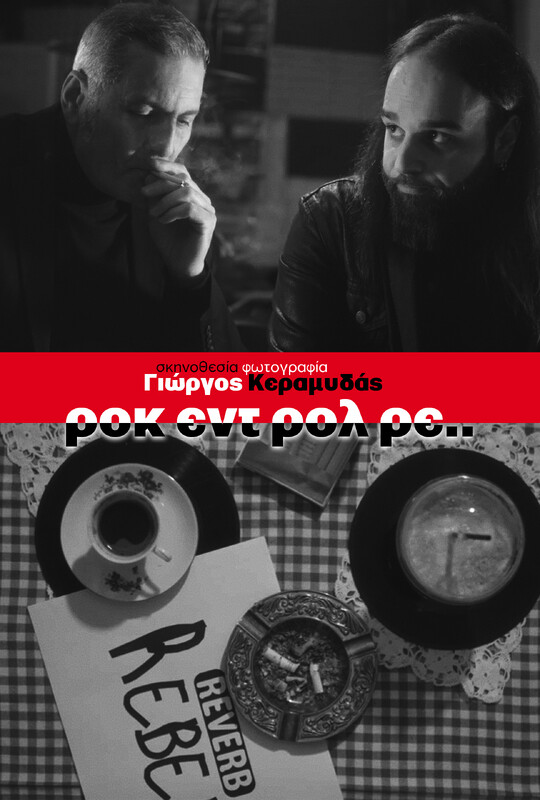
Rock ’n’ Roll, Damn It! marked a substantial shift toward comedy, dialogue and actor direction. The story concerns a man who is intensely committed to creating the ideal garage punk band. The other musicians do not share the same degree of dedication.
As part of the assignment, I had to follow the cinematography and aesthetic logic of a pre-existing film. The scene had to be able, in theory, to form part of that work, so the cinematography, camera placement, rhythm and overall presentation had to remain consistent with its original cinematic world.
This condition required me to work within an already established style. I had to observe how the original film placed people within the frame, used pauses and allowed dialogue to develop through static, observational shots.
The approach was influenced by Jim Jarmusch’s Coffee and Cigarettes. The camera allows dialogue, silence, interruption and reaction to create the rhythm. The comedy arises from the contrast between the seriousness with which the protagonist approaches his plan and the awkwardness or indifference of the others.
I paid greater attention to lighting the actors and separating them from the environment. I also used different decorative lighting, which gave the image depth and reinforced the sense of a musical space.
The film was especially important for my relationship with actors. The workshop experience I had gained before Eternal Home helped me pay greater attention to the characters’ intentions, performance rhythm, pauses and listening between actors.
The weight lay in the dialogue and its delivery. I had to understand when a line needed to be spoken quickly, when a pause created comic tension and how a small reaction could change the entire scene. Visual narration remained central, but dialogue now acquired its own dramaturgical force.
Literal death is absent from the story. The film deals with a smaller form of loss: the death of an artistic expectation. The band that exists in the protagonist’s imagination is unable to acquire real life.
The experience of Rock ’n’ Roll, Damn It! contributed directly to the creation of Strange Daniel. The world of musicians, the anxiety surrounding artistic recognition, the work with several—and in fact the same—actors, and the dramaturgical use of dialogue later carried over into a larger and darker film.
A.I. How I Learned to Love the Singularity
Handheld camera inside a car, blown-out white background and time as a mechanism of pressure
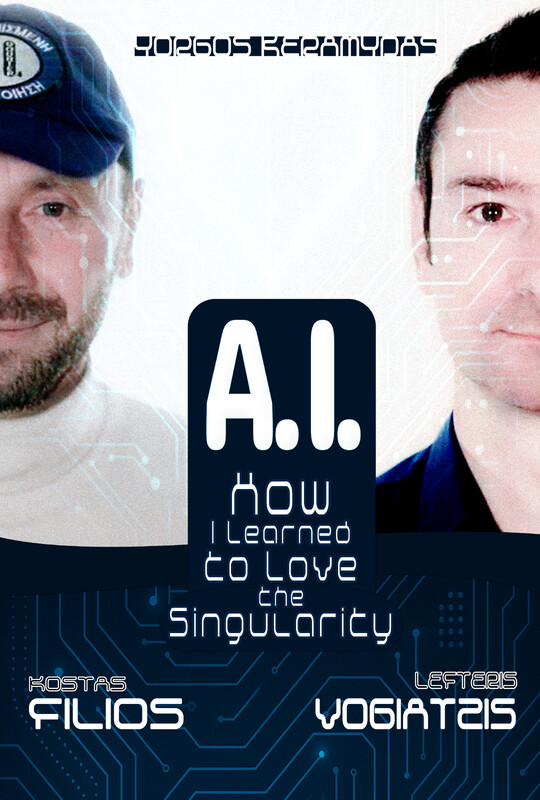
A.I. How I Learned to Love the Singularity transfers the theme of confinement from the house to the car and from family or psychological pressure to the field of labour. A delivery driver tries to satisfy the demands of an artificial intelligence system that evaluates every delivery, constantly reduces the time available and imposes ever greater penalties.
The film was my first experience of shooting inside a car. The restricted space affected the position of the body, the camera angles and the possibilities of movement. I again used a handheld camera so that the instability of the image would convey bodily pressure, the movement of the vehicle and the character’s growing tension.
The handheld camera had a different function from the one it had in Metamorphosis. There it followed the inner destabilisation of a woman. In A.I. How I Learned to Love the Singularity it records a body pressured to follow the rhythm of a system, carrying the external pressure imposed on the hero. The vibrations, the restricted angles and the closeness to the face create the sense of a mobile workspace that becomes a trap.
For the second character I used a completely white and deliberately blown-out background. The absence of visible information around him disconnects him from a specific physical space. He seems to exist in an environment without materiality, like an image generated by the system itself.
The contrast between the unstable, restricted car and the overlit white background organises two different realities. The driver exists in a space full of obstacles, motion and bodily danger. The other presence appears in a space without visible limits and without consequences.
The voice of the artificial intelligence uses neutral and apparently helpful language. The worker’s experience becomes increasingly unbearable. The contrast between the system’s calm tone and the worker’s exhaustion creates the film’s main dystopian tension.
Editing takes on a central dramaturgical role. The acceleration of the shots, the repetition of commands and the accumulation of notifications turn time into an instrument of pressure. The spectator experiences the rhythm imposed on the character.
The worker is gradually transformed into performance and score. The system reads his time, speed and obedience. Personal experience disappears inside measurement.
Death appears here less as a threat to the body than as a threat to human identity and to the character’s very being. By the end, the courier becomes part of the system itself. The transformation functions as a symbolic death of individuality and personality.
Strange Daniel
The larger synthesis of the earlier trajectory and the practical application of psychoanalytic theory
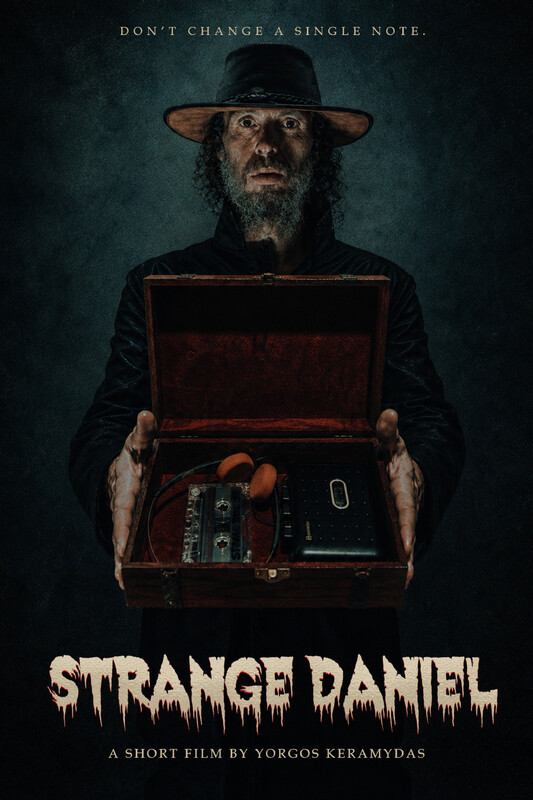
Strange Daniel is the longest film of this period and a synthesis of many elements that had developed in the previous works. Its relationship with Rock ’n’ Roll, Damn It! is direct because of the world of musicians and the desire for artistic recognition. At the same time, its construction integrates techniques, themes and theoretical concerns from the whole preceding trajectory.
The main character is a musician who wants to create a song capable of making him famous. When he receives a mysterious musical piece, he is led into a nightmarish studio where recognition demands obedience.
The film can be read on three levels. On the first, it functions as a supernatural horror story. Strange Daniel may be a real presence offering the musician a Faustian deal. On the second, the experience may be an expression of the protagonist’s psychological collapse. On the third, the story examines artistic labour in an environment where recognition is tied to adaptation to the demands of others.
The cinematography follows a mixed strategy. There are static shots, but the film relies mainly on handheld camera. The choice changes according to the character and the narrative function of the scene.
The musicians are filmed in static shots with electronic zoom. The technique is related to the one I had used in The Sociopath. The mechanical approach to the faces creates a feeling of the uncanny. The musicians appear less human, as if they had already been disconnected from ordinary behaviour.
The protagonist is filmed mainly with a handheld camera. The instability of the shot follows his psychological and bodily experience. As he loses control, the frame itself struggles to retain stable orientation.
The opposition between the musicians’ stillness and the protagonist’s mobility creates a formal conflict. The others seem already to belong to the strange mechanism of the studio. The protagonist remains unstable because he is still trying to understand and resist what is happening.
From Play Deaf returns the dramaturgical significance of sound and of information that lies beyond what is directly visible. Voices, whispers and musical sounds create a space larger than the one the spectator sees.
From Metamorphosis returns subjective experience and the gradual change of identity. From Eternal Home returns suspense produced through the relations among characters, space and objects. From The Sociopath return the electronic zoom, the uncanny and access to an inner world that would normally remain hidden.
Rock ’n’ Roll, Damn It! contributes the world of musicians, the experience of actor direction and the importance of dialogue. From A.I. How I Learned to Love the Singularity return the handheld camera, the closed space that becomes a mechanism of pressure and the subjection of a person to a system of rules.
The longer duration allowed a more complex development of characters, atmosphere and interpretive levels. The film had to manage more scenes, more actors and a gradual movement from the recognisable world of music to a space of psychic and supernatural horror.
Its making coincided with my systematic study of psychoanalytic film theory. Strange Daniel was designed as a practical investigation of concepts related to Freud, Jacques Lacan, Christian Metz and psychoanalytic readings of Hitchcock.
The protagonist’s desire is born from a sense of lack. His personal value depends on future recognition. The song promises to fill that gap, yet the promise keeps desire active and increases his dependence. Success is constantly displaced to a next stage of obedience.
Strange Daniel functions as an intrapsychic Other. He condenses the protagonist’s desire, his guilt and the demands he has internalised from the music industry, the audience and the social gaze. The whispers can be heard as a superegoic voice demanding that he continue and prove his worth.
The underground studio is linked to the unconscious. Descent into the space is also a descent into a psychic field where fears and desires acquire an image. The dreamlike structure allows the condensation of different figures and demands into the form of Strange Daniel. Displacement transfers the anxiety of artistic failure into a system of irrational rules.
Subjective shots place the spectator inside the protagonist’s perceptual field. Prisms, double images, reflections, low shutter speeds and unstable movement disrupt visual coherence. The distortion was largely created during shooting, so that instability would become part of the material image itself.
The mirror has a decisive function. In Lacanian theory the mirror image offers the subject a promise of coherence. In Strange Daniel, the reflection leads instead toward the dissolution of that coherence. Identification with the Other alters the boundaries of identity.
Death is the price of desire and the final form of identification. The musician gains the possibility of recognition and at the same time loses the possibility of experiencing it as a free creator.
In Cold Love
Photography, lighting, camera angles and elliptical knowledge

In Cold Love returns to domestic space and to the management of knowledge. A woman is in the living room watching on her laptop what her partner is saying to another woman. The certainty of betrayal changes her attitude and organises her preparation for his return.
I placed particular emphasis on photography, lighting and camera angles. The focal lengths of 16mm and 30mm alter the relationship of the characters to the apartment. The 16mm allows space to surround the heroine and emphasise her isolation, while the 30mm compresses the environment and turns emotional coldness into a sense of entrapment.
The two characters are filmed almost always in separate shots. This choice was deliberate, because the emotional distance already exists from the beginning of the film. They do not exchange dialogue within a shared frame. The only moment in which they appear together is organised as a relation of height and control, with the woman in a higher position observing the man.
In the film I played the male character and spoke on camera. The experience differed from The Sociopath, where the character’s entire voice functioned as an internal monologue.
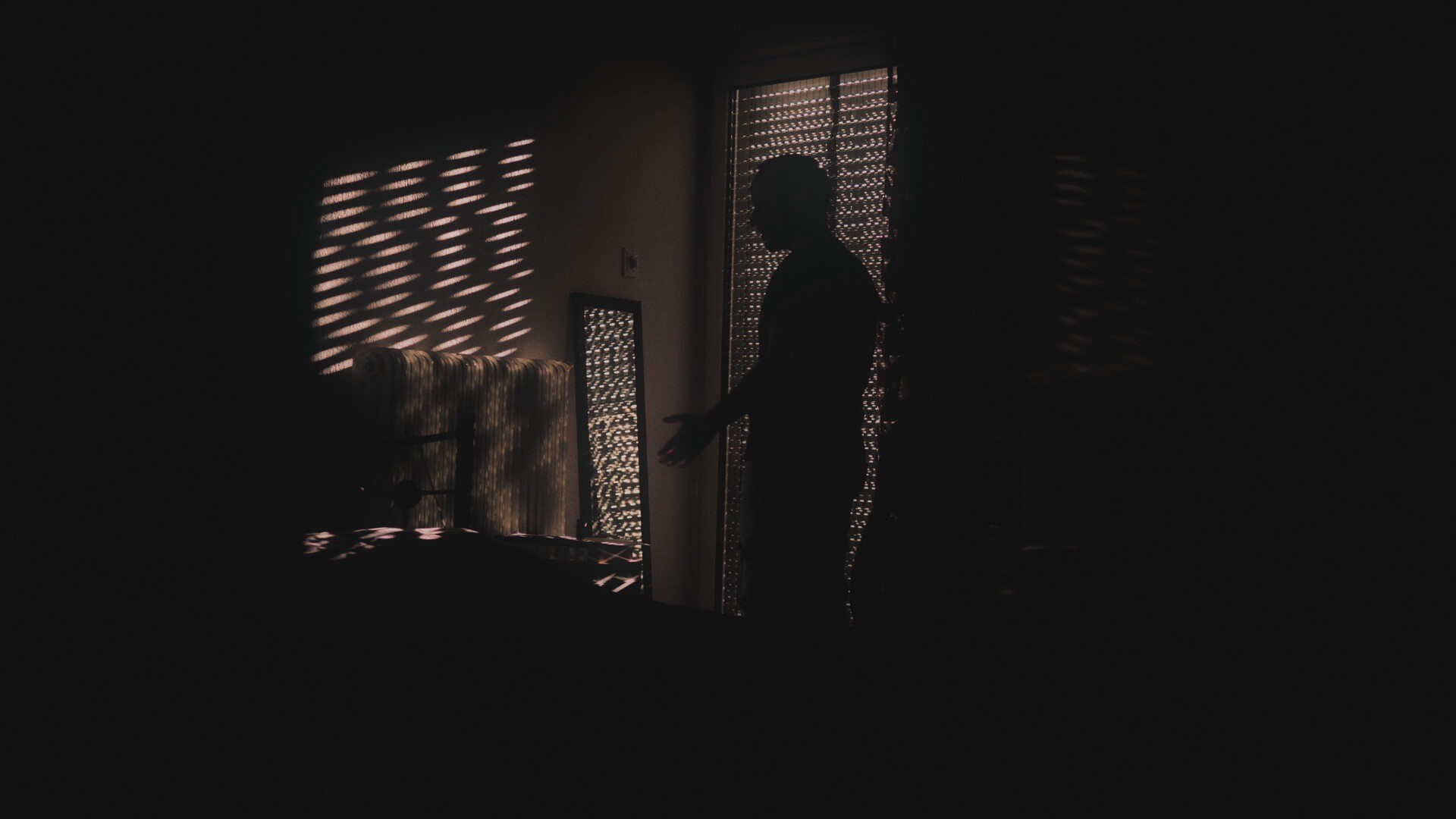
The lighting relies mainly on available light. The woman’s side has more diffused light, while the man appears as a figure in front of strips of light and shadow created by the shutters. The photography visually separates the two worlds before the conflict is completed.
The narration is organised around a difference of knowledge. The woman knows about the betrayal, the man does not know that he is being watched, and the spectator shares her knowledge without immediately knowing the full extent of her preparation. In narratological terms, focalisation remains mainly on her side, but it is still partial because her plan is not fully revealed. This unequal distribution of knowledge continues the Hitchcockian logic of suspense. The spectator knows that a confrontation is being prepared without yet knowing its exact form or outcome.
Editing maintains a slow rhythm and uses ellipses. An action may appear after it has already begun or may be completed after a cut. Fade to black, J-cuts and L-cuts connect images and sounds and allow information to pass from one shot to the next without continuously recording every intermediate movement.
The final shot gathers the climax within the same frame. The coffee pot is in focus in the foreground, while in the background the man’s figure collapses completely out of focus. The focus choice retrospectively links the coffee to its outcome and confirms death without shifting the camera from the object to the body.
Oneiroramma
Long-duration movements, revelations from the close to the wider frame and a dreamlike puzzle

Oneiroramma attempts to render an inner experience of betrayal, guilt, loss and psychic confinement. The narration is organised associatively, like a dream or a nightmare, and does not ask the spectator to reconstruct with precision an objective past.
Its central narrative object is the man’s blouse, marked by a large bloodstain. It returns throughout the film as a carrier of guilt, loss and conflict. The stain suggests the man’s death or his definitive loss from the heroine’s life, turning the object into a material trace of mourning and a painful residue of experience.
I placed special weight on the relatively slow movements of the camera. Many shots begin as close views and move outward, so that the spectator first tries to understand what is being seen and gains the full context only as the frame opens up. The revelation of space, objects and people gradually completes the information that the close view had withheld.
The movement also works as a distancing from the heroine. The gaze is not limited to her immediate subjective viewpoint. Through camera movement the spectator often seems to observe like a fly in the room. In other scenes, the characters look toward the lens of a static camera, creating a more direct relation to subjective experience.
My study of Freud and Metz had already influenced my thinking through Strange Daniel. In Oneiroramma the dreamlike form turns more toward memory, guilt, betrayal and the difficulty of accepting loss. Condensation and displacement allow an object, a sound or a movement to gather more than one psychic function.
The blouse passes through different actions and states until the final moment, when the heroine sews it onto her own body with needle and thread. The act turns mourning into bodily attachment. Instead of removing the trace of loss, she incorporates it onto herself.
The black-and-white photography, the 16mm lens, the claustrophobic compositions and the non-realistic lighting were influenced by Roman Polanski’s Repulsion. The slow movements, the static shots with subtle electronic zoom and the transitions that turn red before dissolving into black create a trap that feels more psychotic than aggressive.
Sound also works associatively. Environmental sounds, voices from adjacent rooms, the tap, the fly, the clock and the music do not always follow realistic continuity. Image, rhythm, action and sound carry the weight of the experience without offering a single explanation.
Cleave
Static observation, crucial pan and tilt, varied lighting conditions and grief as attachment
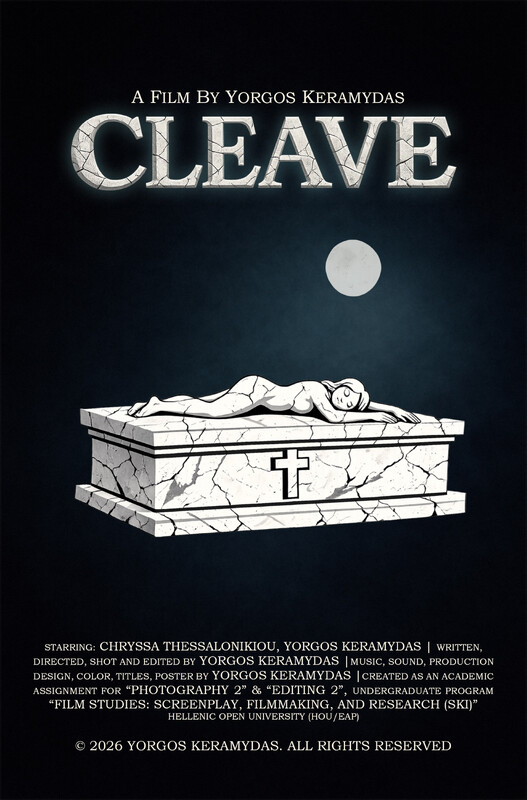
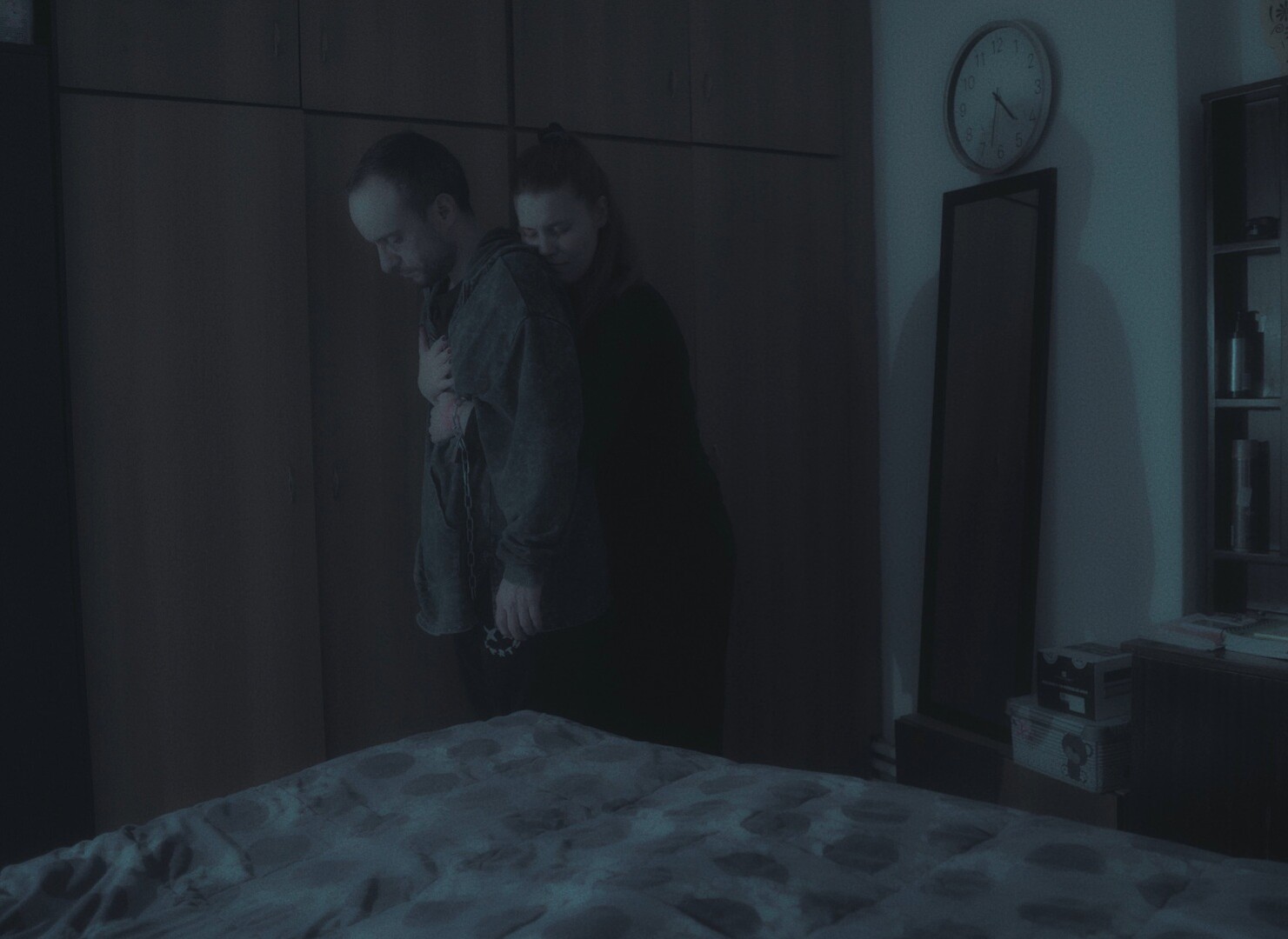
Cleave places death at the centre of the image. A woman refuses to separate from her partner’s dead body and links his body to her own by means of a chain and handcuffs. Everyday actions turn into rituals for maintaining the relationship.
The camera remains static for most of the film. This stability allows the spectator to observe bodies, small movements and gradual decay within the space. Shot duration becomes especially important, because grief is presented as a state of remaining.
At the level of narratology, story time extends over a longer period than the time devoted to it by the narration. Ellipses compress successive stages of decay and mourning into a small number of everyday rituals, while the duration of particular shots slows down the experience of the present. The contrast between temporal compression and remaining within the shot expresses the heroine’s condition. External time moves forward while she remains bound to the same loss.
In retrospect, this form can also be read through Gilles Deleuze’s concept of the time-image. The heroine’s actions do not form a route that changes the situation or leads to a resolution. Dressing the dead man, eating and sleeping beside him repeat and preserve a present that has already ended. The man exists simultaneously as a material body in the present and as a relationship that belongs to the past. Time is therefore not perceived only through the development of events. It appears directly as an experience of stillness, memory and the inability to separate.
I used only a few pan and tilt movements at crucial points. Because most of the film is static, every camera movement gains increased weight.
I also created several different lighting conditions. These changes made the film richer photographically and allowed the same space to acquire different psychic qualities. Light changes the heroine’s relation to the body, to time and to reality.
At first the light retains a sense of everyday life and gradually intensifies decay, isolation and the ritual dimension of the actions. The varied lighting conditions function as indications of the film’s progression, visualising the heroine’s personal experience in an expressionistic way.
The title is based on the double meaning of the English word. To cleave can mean to separate and to cling. This double direction organises the heroine’s psychic state. She needs to detach herself from the dead man and at the same time wishes to remain united with him.
The film works without dialogue. Body, chain, handcuffs, lighting, space and sound carry the narrative. Colour gradually withdraws, following bodily and psychological deterioration.
The 1.37:1 aspect ratio narrows the horizontal field and shifts the weight from the space to the two bodies. The almost square frame concentrates attention on their tight relationship, on the short distance imposed by the chain and on the difficulty of any independent movement.
The element of body horror arises from the conflict between desire and materiality. Love seeks duration. The dead body follows biological decomposition. The chain makes attachment visible and turns emotional dependence into physical restriction.
Cleave brings together several of my earlier concerns. Dialogue-free narration returns, along with the closed house, the object as a dramaturgical sign, the body as a carrier of meaning and a character’s attempt to preserve something that has already been lost.
Sleep Instructions for Mortals
A frozen body, stillness and a world of objects that goes on

Sleep Instructions for Mortals examines insomnia, stillness and the fear of death. A man wakes up in the middle of the night and tries to take care of small pending tasks. This movement is not really about tidying the room. It is an attempt to control something, because the larger issue, the fear of death, cannot be organised.
The form of the film begins from the experience of insomnia. From the moment fear appears, the body struggles to continue normally. The shots freeze for the hero, while the television keeps functioning and becomes the main source of movement, light and rhythm.
The contrast between the frozen body and the moving television image makes duration palpable. Human movement is suspended, yet the mechanism goes on. Sound, the light of the screen and the programme sustain temporal flow even when the body seems to have stopped.
At the level of narration, the protagonist’s internal voice expresses his fear directly, while the television answers him in a cold, procedural register. The television voice does not operate as a realistic external source, but as an impersonal form emerging from his inner world. At first it exposes his attempt to turn fear into control and instructions. Gradually, however, the instructions change direction. They do not promise to neutralise death, but lead him to leave unfinished things open and accept that objects can simply wait. When the voice of the instructions becomes his own at the end, the inner conflict reaches a small agreement with time and a limited hope for morning.
Death appears as an awareness of human fragility. The glass, the charger, the alarm clock, the message and the other objects may remain after the person. They do not feel anguish and they do not know absence. The duration of the material world is set against the temporariness of the body.
The connection with Heidegger lies in the awareness of one’s own end. Here that thought does not lead to an abstract philosophical formulation. It enters an everyday room, interrupts movement and changes the perception of the most ordinary things.
The film uses everyday objects as semiotic elements. In semiotics, the meaning of an object is not fixed, but is shaped by the narrative context in which it appears. The glass, the charger, the alarm clock, the garment and the message therefore remain the same objects, while what they mean gradually changes. At first, they are connected to small unfinished tasks that the protagonist tries to control because “at least these things obey”. Through the television instructions, the same objects eventually become associated with waiting, continuity and the hope that there will be another morning.
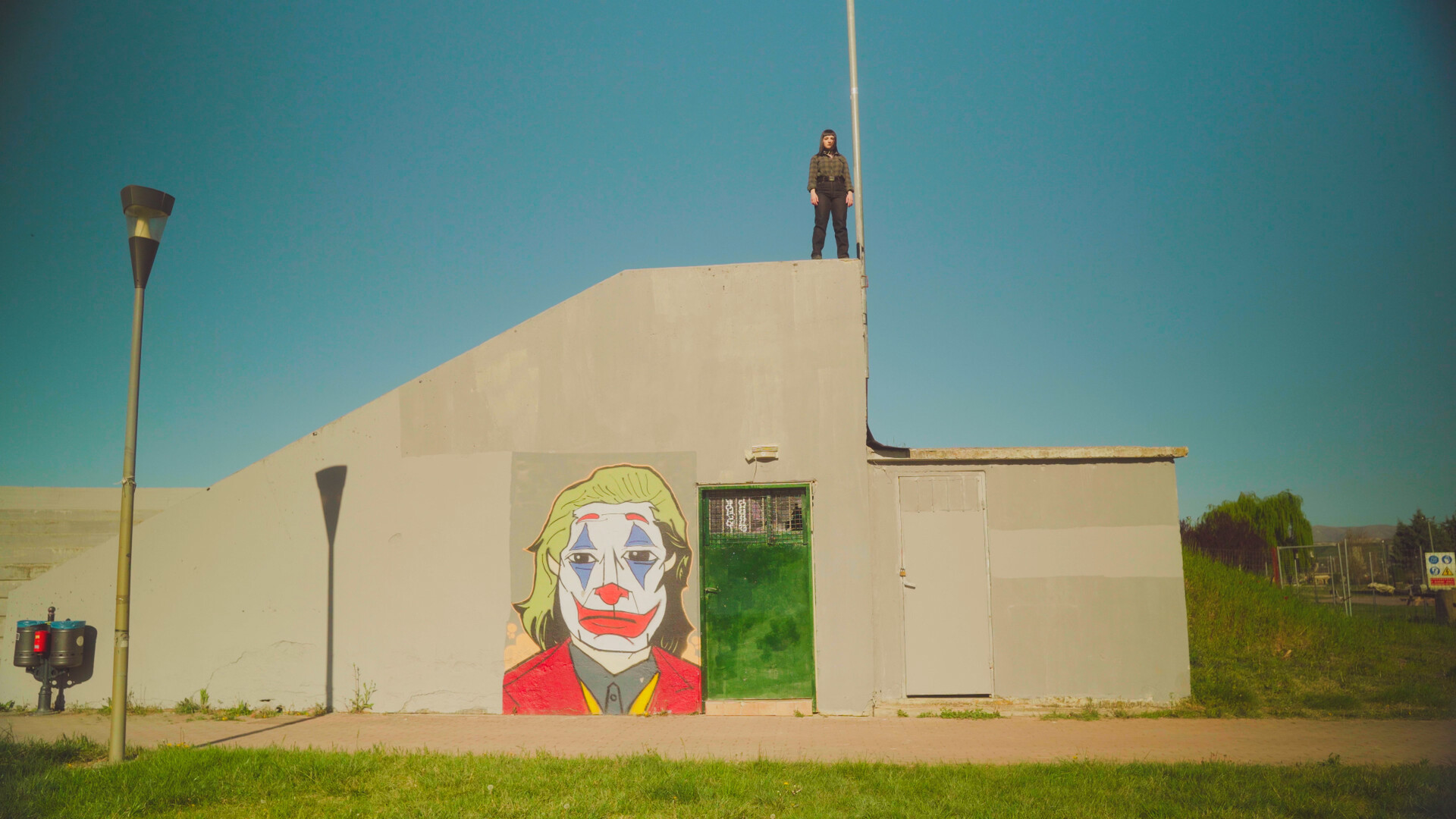
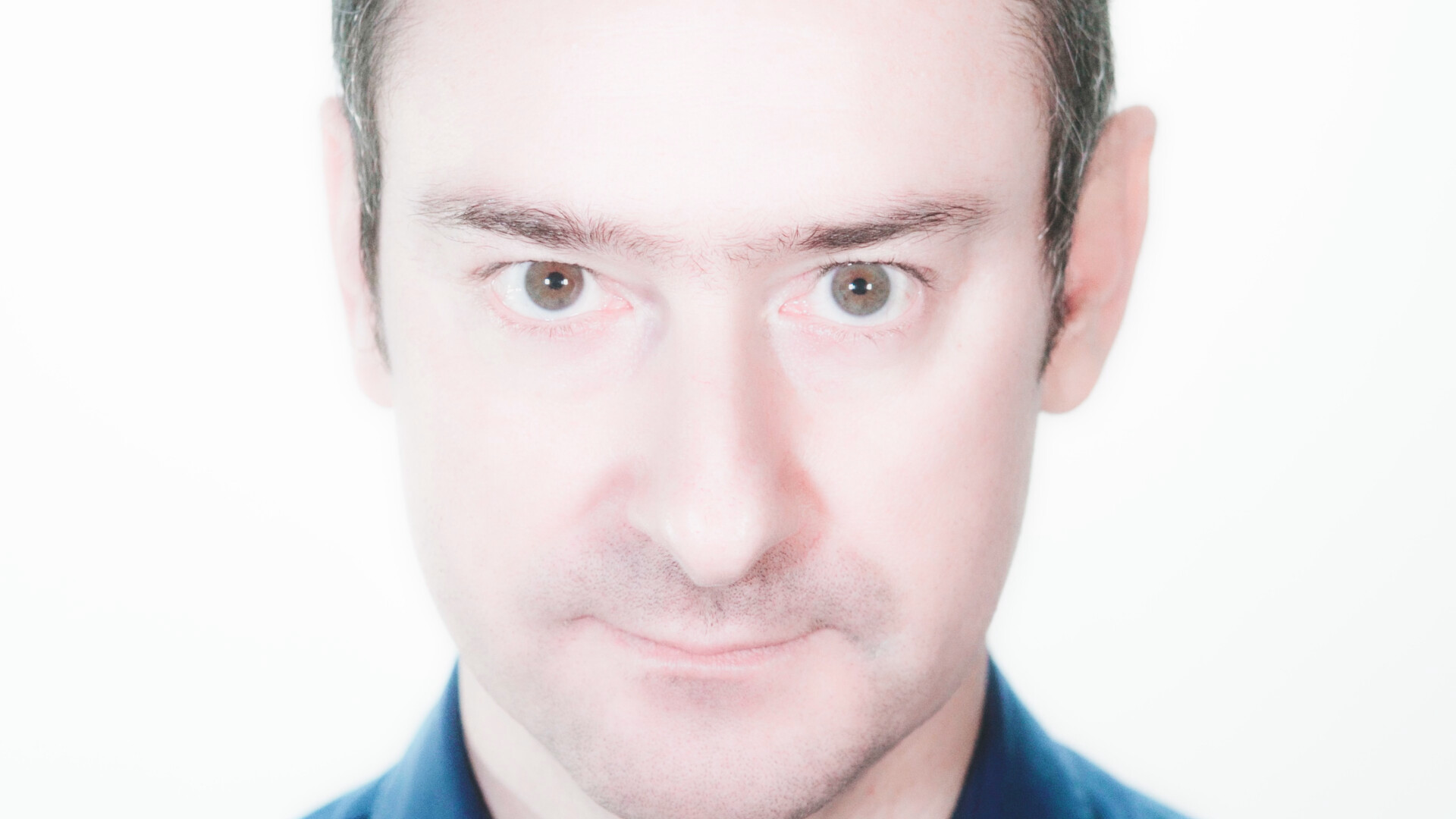
Visual notes
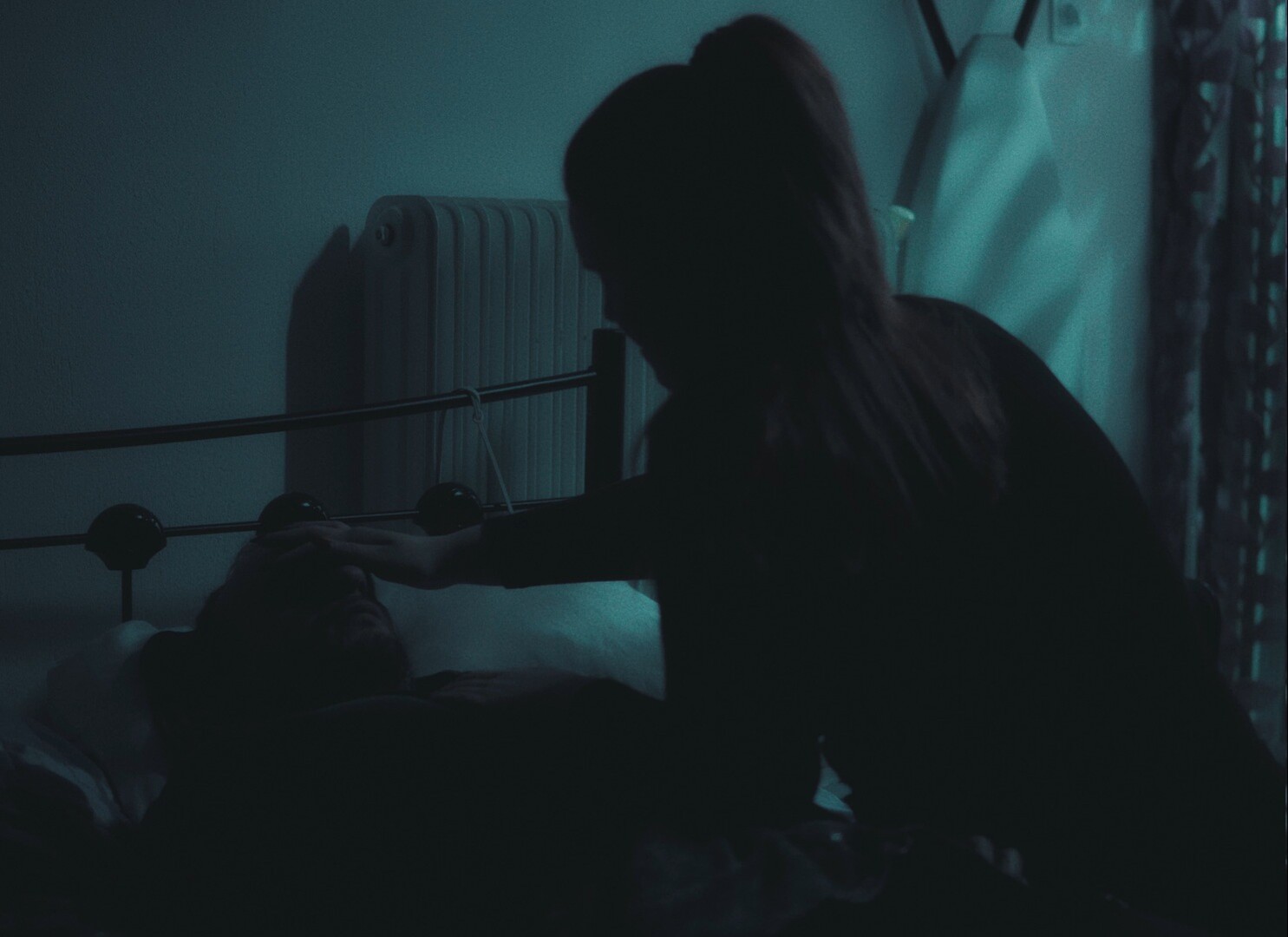
Selected stills from the official FilmFreeway project pages



Death as a Central Axis
Threat, corpse, memory, loss and awareness of mortality
Death is a deliberate central axis of my filmmaking because it is an issue that constantly returns in my thought and in my interests. It is not limited to stories in which a corpse appears. It takes the form of threat, guilt, loss, erosion of identity and awareness of mortality.
In Play Deaf it is the possible endpoint of the violence heard behind the wall, creating the responsibility to intervene. In Eternal Home it has already happened and organises a network of family loyalty, concealment and moral ambiguity. In Metamorphosis it is linked to disappearance, change and a sense of invulnerability.
In The Sociopath the dead body has been incorporated into daily life without mourning. In Rock ’n’ Roll, Damn It! loss concerns the death of an artistic plan. In A.I. How I Learned to Love the Singularity the courier ends up becoming part of the system itself. His transformation functions as a symbolic death of individuality and personality.
In Strange Daniel death completes the loss of creative autonomy. In In Cold Love the heroine’s cold preparation leads the conflict toward its extreme consequence. In Oneiroramma the blouse with the bloodstain signals the death or definitive loss of the man and becomes the object around which mourning is organised.
In Cleave death is the material reality the heroine refuses to accept. In Sleep Instructions for Mortals death becomes the cause of insomnia and the inevitable limit against which human fragility is felt.
Auteur theory allows this repetition to be examined as an element of a personal cinematic language.
Form as Part of Narration
Technique returns each time to the place where the story needs it
The evolution of the films can be observed through my relationship with the camera. In Play Deaf absolute stillness expresses entrapment and lack of access. In Eternal Home pan and tilt follow the protagonist as he moves, carries things and digs in the yard, linking bodily action with concealment.
In Metamorphosis the camera enters my hands for the first time and follows the heroine’s psychological change in daylight. In The Sociopath the static camera and electronic zoom create the sense of an uncanny and disembodied gaze.
In Rock ’n’ Roll, Damn It! form follows the aesthetic of a pre-existing film and lets dialogue and performance shape the rhythm. In A.I. How I Learned to Love the Singularity the handheld camera conveys bodily pressure inside the car, while the blown-out white background separates the technological mechanism from the material world.
In Strange Daniel different techniques coexist. The musicians are filmed in static shots with electronic zoom and appear less human, while the protagonist remains unstable within the handheld camera.
In In Cold Love focal length, lighting and the separation of the characters into distinct shots organise distance and knowledge. In Oneiroramma slow movements from the close view to the wider frame gradually reveal the full context of an associative and dreamlike experience.
In Cleave the static camera expresses remaining within grief, while the few pan and tilt movements mark crucial changes. The 1.37:1 aspect ratio concentrates attention on the two bodies and on their tight relationship. In Sleep Instructions for Mortals, the freezing of the body and the continuation of the television turn time into a visible conflict between human stillness and the operation of the machine.
This evolution does not follow a simple path from stillness to movement. Each technique returns whenever it responds best to the needs of the narration.
Closed Spaces and Psychic States
The house, the car, the studio and the bedroom as psychic fields
A recurring element is the restricted space. The stories unfold in apartments, yards, cars, studios and bedrooms. These spaces are connected to the conditions of no-budget independent production, but over time they acquired a stable aesthetic and thematic function.
In Play Deaf the wall separates the protagonist from the violence and carries its sound. In Eternal Home the yard of the family house in the village becomes a space of carrying, digging and concealment. Though it is outdoors, it morally confines the protagonist around the crime and the family property.
In The Sociopath the living room becomes a space of decomposition. In A.I. How I Learned to Love the Singularity the car becomes a mobile space of confinement. In Strange Daniel the studio takes the form of a psychic basement.
In In Cold Love the apartment separates the two characters into different rooms and different shots. In Oneiroramma space is gradually disclosed through slow camera withdrawals. In Cleave the domestic space artificially preserves the relationship with the dead because it functions as a material carrier of their shared life and experiences. In Sleep Instructions for Mortals the everyday room is transformed by nocturnal anxiety and functions as an interior psychic space.
The relationship between space and psyche is expressed through light, colour, focal length, movement and camera position. The black-and-white yard in Eternal Home, the colours of The Sociopath, the strips of light in In Cold Love, the slight distortion in Oneiroramma and the gradual desaturation in Cleave all alter the emotional function of the spaces.
Objects as Carriers of Meaning
From dramaturgical preparation to semiotic relation
Objects already had a place in my first personal list, because I believed that an element used at the crucial moment ought to have been introduced earlier. This principle came from classical dramaturgy and from the need to prepare the resolution. Over time, objects acquired a broader function.
In Eternal Home the tools, the soil, the mobile phone and the key participate in the management of information and in concealment. In In Cold Love the laptop becomes the means of surveillance, while the coffee pot turns in the final shot into the carrier of decisive information.
In Oneiroramma the blouse with the bloodstain gathers loss, guilt and mourning. Its reappearance and its sewing onto the heroine’s body transform the object into a bodily relationship with trauma.
In Cleave the chain and the handcuffs make psychic attachment bodily. In Sleep Instructions for Mortals the glass, the charger, the alarm clock, the message and the television organise the difference between the fragility of the body and the duration of the material world.
Semiotics helped me see that the meaning of an object arises from its relation to the other shots, the sound, the character and duration. The same object may begin as part of everyday life and later acquire the function of a trace, evidence or threat.
The Spectator’s Position
Knowledge, identification, doubt and ethical involvement
From my first film onward I have been occupied by the relationship between the character’s knowledge and the spectator’s knowledge. My initial wish for the camera to remain close to the protagonist’s side was linked to identification. Theoretical study helped me understand that identification does not depend only on a literal subjective shot.
In Play Deaf the spectator shares the protagonist’s limited access. In Eternal Home the audience knows about the crime and waits for its disclosure to the other characters. In The Sociopath the hero’s voice grants access to his thoughts and creates the sensation of a forbidden listening.
In In Cold Love the audience knows about the infidelity but not the woman’s plan. In Strange Daniel subjectivity becomes unstable. The spectator sees through the protagonist’s distorted perception and cannot decide whether the experience is supernatural, psychological or dreamlike.
In Oneiroramma the spectator is asked to connect the shots like pieces of a puzzle. Movement from close view toward the wider shot adds information without imposing a single interpretation. In Sleep Instructions for Mortals the second person reduces the distance between the voice and the audience.
The spectator’s position is also an ethical one. In Play Deaf one is invited to consider what one would do in the face of violence. In Eternal Home one understands the son’s motives while watching his complicity. In The Sociopath one is placed close to a character who does not share ordinary emotional reactions.
In Cleave the spectator watches an action that provokes repulsion and at the same time arises from an inability to accept loss. In Sleep Instructions for Mortals one is confronted with the idea that image, television and objects can continue after the human body.
The Evolution of the Method
Each work revised one part of my initial understanding
The trajectory of the films does not follow a simple line of technical improvement. Each work forced me to reconsider a different part of my initial understanding.
Play Deaf confirmed the power of restriction, of off-screen sound and of a clear management of information. Eternal Home expanded the dramaturgical scale, the use of actors, objects and camera movement. At the same time, my search for actors led me to Voreio Pedio and to the workshops that influenced my direction and guidance of performers.
Metamorphosis brought me for the first time to handheld camera, natural light and narration through the heroine’s voice. The Sociopath gave a greater place to colour, electronic zoom, my own performance and internal monologue.
Rock ’n’ Roll, Damn It! helped me work on dialogue, performance rhythm and the lighting of both actors and background. A.I. How I Learned to Love the Singularity brought me for the first time to shooting inside a car and to the use of handheld camera in order to convey the external pressure the hero experiences.
Strange Daniel gathered the previous inquiries into a larger film. It combined static camera, electronic zoom, handheld camera, dialogue, the direction of multiple actors, music, closed space and psychoanalytic theory.
In Cold Love brought greater precision to the relation among photography, lighting, camera angle, focal length and elliptical narration. The separation of the two characters into separate shots helped me use composition as an expression of their emotional distance.
Oneiroramma turned toward slow movements that open from the close view to a wider context, toward the blouse as a recurring symbol and toward the connection of image and sound within a dreamlike narration. Cleave reduced conventional action and shifted the weight toward static observation, duration, the 1.37:1 ratio, crucial pan and tilt movements and changing lighting conditions.
Sleep Instructions for Mortals explores time formally through the freezing of the body and the continuation of the television image. Form turns mortality into a visible relation among human stillness, sound and mechanisms that continue to operate.
Theory affected the creative process in different ways. At times it preceded the film and took direct part in its conception, as in Strange Daniel. In other cases it allowed me to understand afterwards choices that had begun more intuitively.
A Journey That Remains Open
Before my studies I already had a relatively clear image of the kind of cinema I wanted to create. I wanted understandable stories, controlled information, ordinary people inside intense problems, visual narration, subjectivity, moral causality and careful use of colour, music and editing. These principles already appear in Play Deaf.
The trajectory of the later works expanded that initial basis. The camera moved from complete stillness to handheld movement, pan and tilt, electronic zoom and long-duration shots. None of these techniques acquired permanent priority. Each returns whenever it responds most effectively to the needs of the narration.
Dialogue acquired dramaturgical force through Rock ’n’ Roll, Damn It!. The direction of actors became more conscious after my contact with Voreio Pedio and my participation in the workshops. That experience also led me to my own presence in front of the camera beginning with The Sociopath and In Cold Love.
Photography began to function as a system of relations among light, colour, focal length, angle and visual weight. Editing evolved from a tool of clear narration into a means of shaping time and bodily experience.
A theoretical examination of Hitchcock’s films and a study of Deleuze’s theory helped me understand suspense as a relationship among knowledge, people and objects. Existential philosophy brought freedom, responsibility and death to the foreground. Psychoanalytic theory opened the way toward desire, the gaze, the dream and the dissolution of identity. Semiotics and narratology allowed me to examine with greater precision order, duration, focalisation and the function of objects.
Death remains the central axis that unites this trajectory. Through it I examine responsibility in the face of violence, family guilt, the absence of mourning, artistic frustration, the symbolic death of personality within a system, the dissolution of the ego, betrayal, mourning that attaches itself to an object, the refusal of separation and the fear of mortality.
The films record what I knew and what I was seeking at each stage. They also record the moments when a previous certainty had to change. My cinematic journey is shaped through the constant relationship among idea, theory and practice.
Each new film returns to the same basic questions from a different position. How is the gaze organised. How does an object acquire meaning. How can form support narration. How does a person respond to guilt, desire, loss and death.



